
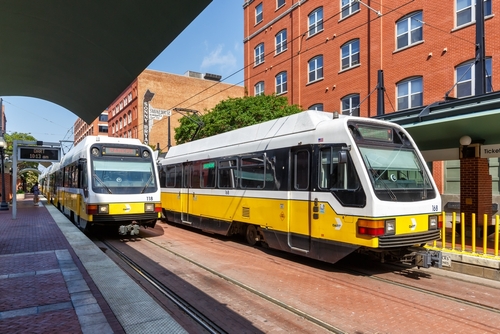
According to a study from the University of North Texas (UNT) Economic Research Group, transit-oriented development in North Texas had a direct economic impact of more than $18 billion over the past 25 years.
The study looked at development within a quarter mile of DART light rail stations and found the area had a $1 billion direct impact between 2022 and 2024 alone.
“The findings are not surprising because we know over the past 25 years of study that transit-oriented development around DART light rail stations results in commerce, tax revenue, and jobs,” Michael Carroll, PhD, UNT’s University Economist & Director of the Economic Research Group, said. “When we center sustainable transportation in development, the result is beneficial in nearly every way.”
The study found that rent premiums in transit-oriented developments were 10 percent higher for residential and 12.6 percent higher for commercial rents than units more than half of a mile from the station. Transit-oriented development also directly created 5,295 jobs and more than $428 million in labor income in the last two years alone.
Construction around DART stations during the two-year time period generated $51.5 million in state and local tax revenue, the bulk of which was from sales tax related to construction of the projects, and about $21.1 million in property taxes.
“When we talk about the role DART plays in the local economy, we mean that in a very literal sense, beyond just moving people to and from their jobs,” Nadine Lee, DART CEO & President, said. “Every dollar generated by and within development around our light rail stations has the ability improve our cities, provide economic mobility and stability to our residents, and grow opportunity for North Texas.”