
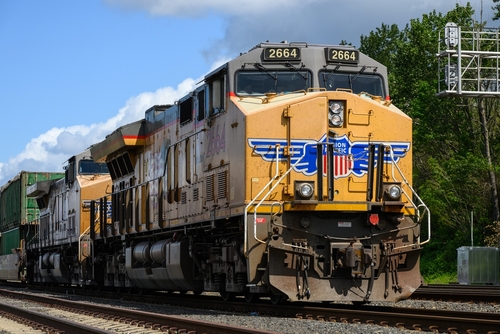
Union Pacific recently recognized 16 of its customers and suppliers with its 2025 Sustainability Partner Awards.
The awards recognize innovative sustainability initiatives and celebrate their customers and suppliers for their commitment to advancing environmental stewardship and sustainable business practices. Now in its third year, the award program highlights organizations delivering measurable progress toward ambitious sustainability goals.
“Union Pacific is proud to stand side by side with our customers and suppliers, working together to find environmentally responsible ways to move freight,” Kenny Rocker, executive vice president – Marketing and Sales, said. “By aligning our efforts, we’re building a stronger supply chain and driving better long-term outcomes for communities across America.”
The company said rail continues to be the most sustainable form of moving freight over land, and that one intermodal train can remove an estimated 500 trucks off the country’s highways. Additionally, that one train uses only one gallon of fuel to move a ton of freight 500 miles. Union Pacific opened the sustainability awards to its customers and suppliers, and was based on an organization’s sustainability efforts, like the use of innovative business practices to reduce their environmental impact, while considering the company’s track record of engaging with and collaborating with stakeholders.
Union Pacific awarded Sustainability Customer awards to: APL Logistics, Dow Chemical, DSL Logistics Inc., General Motors, Graphic Packaging International, LyondellBasell (LYB), Schneider, and Toyota North America. Union Pacific awarded Sustainability Supplier awards to: Capgemini; Chevron; Concentrix; Rail Management Services (RMS), a Carrix Enterprise; Vossloh/Rocla Concrete Tie, Inc.; W.T. Byler Co. LLC – A Quanta Services Company; Wabtec Corporation; and WSP USA.
Winners were honored on Nov. 6 at a ceremony in Omaha, Neb., where the organizations were able to share their initiatives and projects.